Speed-to-Lead: Why the First 5 Minutes Decide the Job
by mperlmutter | November 28, 2026 | Local Marketing

There is a number in local service marketing that quietly determines your revenue more than any other: how fast you respond to a new inquiry.
The research on this is unusually consistent. Contact within five minutes makes you dramatically more likely to win the job than contact in ten or thirty. The gap is not a few percent. It is large enough that a business with the same leads and the same prices can earn several times more by simply answering faster.
Here is what the data says, why it works, and what to do about it.
Why five minutes matters so much
The economics of reaching out
Think about what happens when someone requests a quote from three businesses. They are probably doing this from their phone, in a parking lot, between other things. They are going to call the first one who answers and sounds competent.
When you call back in two hours, you are not competing on price or quality. You are competing against the fact that they already told two other businesses yes.
It is a 21st century problem with a 20th century answer
Most local service businesses still handle inquiries the way they did in 1995: a form on the website, a stack of voicemails, and someone getting to it when they get to it.
Meanwhile the buyer expectation has changed completely. We have been trained by other industries - rideshare, food delivery, retail - to expect a response in minutes. A business that takes three hours to respond feels broken, even if they are excellent.
It compounds across the whole funnel
Speed-to-lead does not just win the job. It wins the customer. A customer whose first contact was instant tends to: - Trust the business more - Be easier to schedule - Be less likely to shop around - Be more likely to refer you
What is actually happening in the first five minutes
The caller is deciding whether you are legitimate
A phone call that is answered, answered by a person who says where they are and what they do, immediately reads as a real business. A voicemail, an email sent next day, or a form response reads as a small operation that might not show up.
They are comparing you to someone else in real time
If they are calling three businesses in sequence, they have your competitors' voices in their head from the last ninety seconds. Whatever you say is being compared to what they just heard.
Silence gets interpreted as "no"
This is the part business owners get wrong. They assume no response means "they are busy" or "they will call back." In practice it reads as "this business does not care" or "this business has already told me no."
Where the leads are getting stuck
Most speed-to-lead problems are not marketing problems. They are operational. The leads arrive; something between the form and the phone call breaks.
The form asks for too much
If your form requires eleven fields, you have lost the lead before you had it. Name, phone, and a general sense of what they need is enough to call them back. Every extra field is a reason to close the tab.
Service, timing, and price questions are for the call. The form's only job is to start it.
Nobody owns the inbox
"Someone will get to it" is how leads die. The answer is not "work harder" - it is a named owner with a checking routine, or an automated response.
Business hours are the wrong model
If your leads arrive at 8 PM on a Tuesday and nobody calls until 9 AM Wednesday, you have lost the race. Your competitors who answer at 8:05 PM have already won.
The phone goes to voicemail during busy hours
Your busiest hours are exactly when leads arrive and exactly when you cannot answer. That is a staffing problem that automation solves better than hiring does.
What to do about it
1. Set the response-time standard and write it down
Fifteen minutes during business hours. Sixty minutes outside them. Put it on the wall. It is a number people respond to.
2. Get an instant acknowledgment
The moment a form is submitted, send a text and an email that say three things: - We got your request - Here is when we will call you (a real time, not "shortly") - Here is what to have ready so the call is fast
The acknowledgment does not replace the call. It buys you the position in line and it stops them from calling someone else.
3. Make the first call tiny
Do not try to quote on the first call. The first call has one job: get a time on the calendar.
"What is your address, what is the service, and when are you available?" That is three questions. You are not selling, you are booking.
Real talk: a first call that tries to quote gets a price objection and a hangup. A first call that books gets a second call where you close.
4. Automate the unglamorous part
There are three things to automate and they are not the ones people expect: - Instant acknowledgment (text + email) - Missed-call text-back - if the call goes to voicemail, an automatic text fires immediately - Round-robin routing - the lead goes to whoever is actually free, not to a shared inbox
The missed-call text-back is the highest-leverage of the three. A large share of calls go to voicemail on the first attempt, and a text within 60 seconds recovers most of them.
5. Track it, or it will not happen
Measure: - Median time from lead to first contact - Percentage contacted within 15 minutes - Percentage contacted within 60 minutes - Contact rate by lead source
If you are not measuring it, you will not do it. And when you can see it, the improvement is usually fast.
The barbershop version
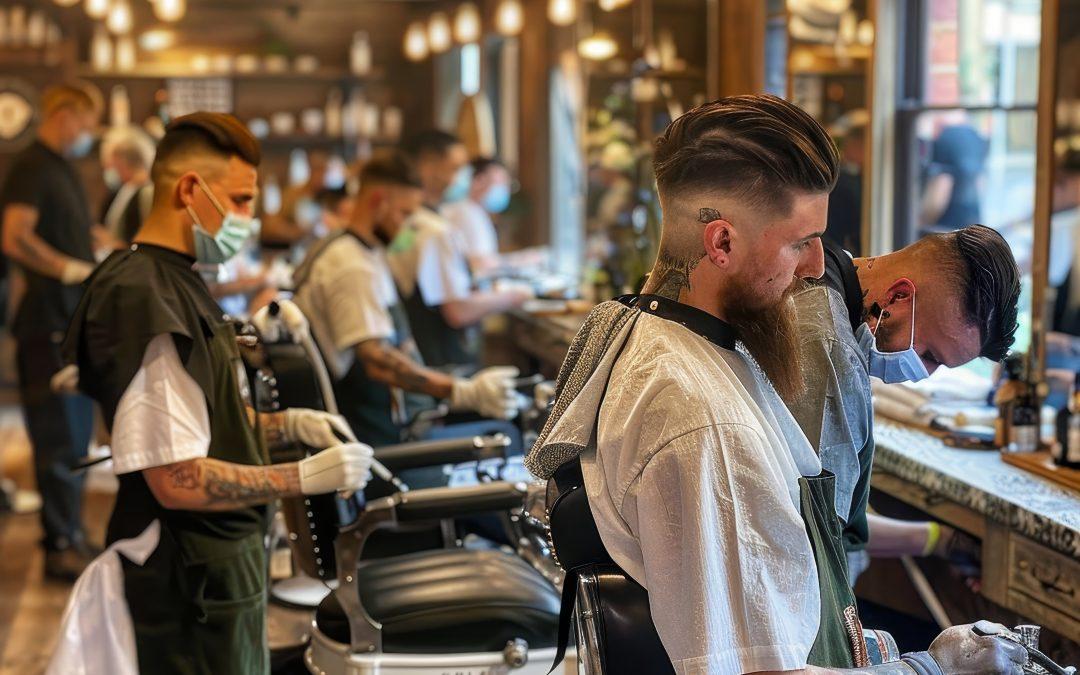
Barbers are the clearest example of a business where speed-to-lead decides the outcome.
A person who wants a cut today is calling around. The shop that answers and says "I have 3:30 or 4:15" gets the job. The shop that calls back in an hour has lost it - not to a better barber, but to the shop that was still awake.
This is also why appointment systems matter so much for barbers in 2026. If your booking takes a phone call during working hours, you are competing with the haircut you are currently giving.
The electrician and home service version
For emergency work - burst pipes, no heat, panel issues - speed is the entire value proposition. A homeowner with water on the floor will hire whoever answers first, every time.
For planned work - rewires, panel upgrades, remodels - it still matters, but you have a longer window. Which means you can be more deliberate about qualifying - and about making sure the person who answers is actually the person who can do the work.
Why the pay-for-performance model fits here
Speed-to-lead is a conversion-rate problem, not a traffic problem. You can generate all the leads in the world and still lose them to a slower competitor.
This is why Risk Free Marketing® is built around completed work rather than clicks. When you are only paying when a job happens, the entire incentive is on the outcome - not on impressions, not on form fills, not on clicks. And outcome-driven marketing gets the speed right, because speed is what wins the job.
Do this first
Tomorrow morning:
1. Find out what your actual median response time is right now. If you do not know, that is your first task. 2. Add an instant text acknowledgment to your form. 3. Set up missed-call text-back. 4. Write down your 15-minute standard.
Those four things are usually less than a day's work and they are worth more than most of the marketing you could buy.
Want this handled?
If speed-to-lead is your biggest leak, and you would rather not pay upfront to find out how much it is costing you, we can find out and fix it - and you only pay out of the results.
Call (424) 999-0653 or email info@yescrew.com. The first conversation is free.
*Curious what your real response time is right now? We will check it for you.*